
I am finally back on this blog, rebranded (at least for now) and ready to take on the world!
I wanted to share something that is very important to me and others too in fact because it has changed my life in more ways than one. Instagram has already seen my post and caption in partnership with Made of Millions. But I figured I should delve a bit more into my story. So here we go, this is the story of my long struggle with obsessive-compulsive disorder and why it needs to be understood better and why sufferers deserve all the help and love they need.
I won’t lie, I used to believe that OCD was just a thing where you want things arranged neatly or in order, tidiness and perfection being the main components. The first time I had heard of the term “OCD” was actually on Disney Channel. Being a young impressionable teenager, I assumed this was true and joined the masses who thought of OCD as a quirk. “I’m so OCD” or “My OCD is not liking this” and other similar phrases are thrown around like it doesn’t mean much. Well, it clearly isn’t anything like the misconceptions portrayed in the media and propagated by the general public. OCD in reality consists of intrusive thoughts that cause great anxiety and then a performance of compulsions to provide relief, though temporary.
I have been getting intrusive thoughts since I was a child, though I did not know it had anything to do with a mental illness. Harming others, people I know in person or even celebrities doing things that are inappropriate, family members doing something strange were the themes and caused me to be upset. But back in those days, I didn’t think too much of them and was able to move on in life with some ease. It wasn’t until the late summer of 2018 that the symptoms developed into something worse. That summer was comprised of anxiety over A-Level results and acceptance into university but also some great memories with friends and family. A holiday in August of that year was a good time of relaxation and where I received my results (spoiler: I got the grades I worked for and was accepted into my first-choice university). So nothing could go wrong from that point, right? Wrong. Returning home and then the subsequent days changed my life forever. Thoughts of a sexual nature of a child I know well and think of as a little sister plagued my brain and would not leave. I cried every day and lived in fear that I was slowly becoming a deviant, something I’m definitely against. So why was I having these thoughts? After doing the traditional search on Google for answers, I did come across users on forums who experienced the same symptoms and that was some reassurance that I was not alone. OCD appeared by name and this is where I began to understand what it truly is. But that obviously did not stop the thoughts from making regular appearances in my mind.
In September of that year, I moved to university for my first year and this was a period where I felt the thoughts were disappearing and I would be fine once again. New friends, flatmates and the exciting life in a big city and at university were proving to be a good distraction and a reminder that life doesn’t have to change, I’m still me. But with any illness comes relapses and that’s exactly what happened with myself. I sought counselling with the student services at university which was helpful but once again, that wasn’t enough. During my second term, sleep became an issue and I was not attending lectures and tutorials regularly. It was hopeless.
By the end of my first year, I sought out counselling again and this time I was urged to visit a doctor and seek professional help. I’m not sure why I didn’t do so sooner but the thoughts of stigma, fear of explaining my thoughts and family perhaps prevented me. I was able to do my exams and life started to look brighter again too. Despite it being the summer and it was close to return home for the holidays, I went to my GP and lifted a huge burden from my shoulders. I spoke to my psychiatrist for the first time on the phone and we arranged to meet once I returned to university. Fast forward to October 2019 and we meet in person for the first time and I proceeded to tell him everything. That was when he officially diagnosed me with Obsessive-Compulsive Disorder, I had my suspicions but didn’t want to self-diagnose but this was the confirmation. I began taking medication and also saw a counsellor again.
Since then until now, I have had many relapses that had me bed-ridden, unable to attend classes and go outside. Literally, I have attended only a handful this whole academic year! With COVID-19 it was also cut short and meant I had to return home, with no updated batch of medication and in an environment I’m not comfortable in. I have been through many extreme periods of darkness, contemplating suicide and even writing a final note. But I’m fighting and with everything I have been through these last nearly 3 years, I suppose I am a fighter after all. There is still a long way to go as I’m waiting for therapy (CBT) but I’m continuing. I’m determined to make my life great again and take back myself, and I sure want this to be the case for everyone else who has OCD.
The reality of OCD is dark. The thoughts we get range from a variety of themes such as harm/violence, sexuality or sexual deviance, existentialism, health and even incest. So you should see now that there isn’t really anything to do with tidying up. Even if there was an involvement of cleanliness, it would be doing so because if you didn’t, something terrible would happen to your family. To give you an honest representation of thoughts in OCD, here are some examples:
If I am using a knife in the kitchen while my mum is next to me, I could stab her to death.
I picked up the child for too long, what if I molested them?
I didn’t wash my hands properly/several times, I’m going to get a disease.
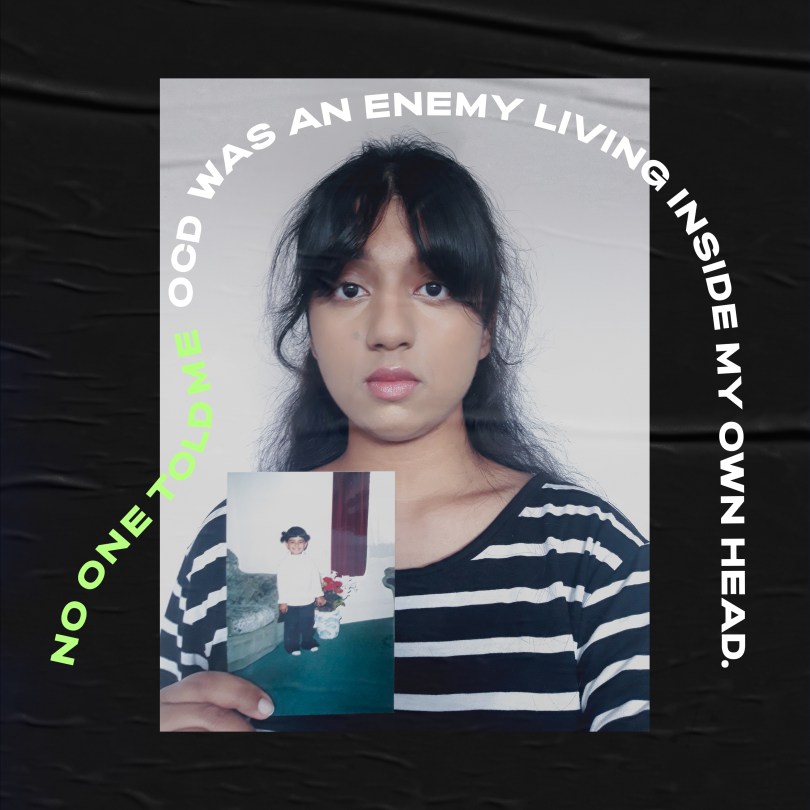
These thoughts can also occur at the most random, or inappropriate moments such as during family/public gatherings, sexual intimacy, meetings/interviews, funerals, weddings etc. Thoughts aren’t the only symptom either, OCD comes with physical sensations, urges/impulses too which causes further suffering. OCD does not care, it just wants to torment you. No one told me that OCD was an enemy living inside my own head.
The stigma surrounding the disorder is so great as has been established. This then contributes to individuals to not seek professional help out of fear, guilt, shame or misunderstanding. It is so crucial that OCD is recognised as a genuine illness and what the symptoms are to break this stigma. Then sufferers such as myself could have been treated much earlier and not suffer in silence for years. I hope the awareness that is brought will change how OCD is perceived. Chrissie Hodges is a great individual who accomplishes this on her YouTube channel and Instagram page. The organisation Made of Millions (who I have partnered with in sharing my story) strive to do so as well. Please check them out!
Thank you for reading, I do hope you are now aware of what OCD is and if you suffer from it yourself, that you know you aren’t alone. Also a special thank you to Made of Millions for encouraging and sharing our stories for their campaign #NoOneToldMe.
Take care of yourselves 🙂
It takes an average of 10 years for a person suffering from a psychiatric disorder to seek help. Half of which start before the age of 14. Each year spent suffering in silence, is a year lost.
This #mentalhealthawarenessmonth, I’m proud to partner with @madeofmillions_ for their #NoOneToldMe campaign focused on bringing awareness to the treatment gap — the long, avoidable years so many of us spend suffering in silence. Learn more at madeofmillions.com. If you’re in the U.S. and experiencing a crisis, text MADE to 741741 for free, 24/7 support.
 cinem(a)shika.