
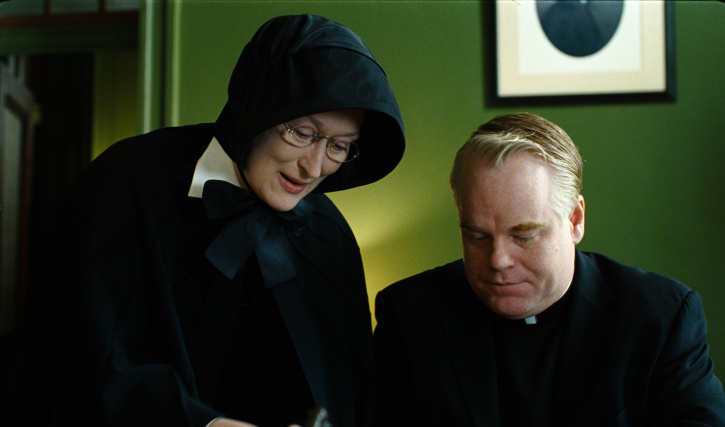
May and June were quiet months and for that I apologise. However, I am back with another review! A recent watch which was a fascinating exercise in representing ambiguity was ‘Doubt’, directed by John Patrick Shanley and starring Philip Seymour Hoffman, Meryl Streep and Amy Adams.
IMDb synopsis: A Catholic school principal questions a priest’s ambiguous relationship with a troubled young student.
SPOILERS AHEAD / CONTENT WARNING: mentions of sexual abuse.
While not a Catholic, I am a practicing Christian woman who attended a Catholic school as a child and is aware of the unfortunate, rampant abuse that exists in the church. ‘Doubt’ appeared as honest as it can be from the Netflix preview that it would delve into this subject.
It should go without saying that the faith has no place for such vile acts against innocents. So many church leaders have a record of covering up sexual abuse instead of cleaning up the priesthood to the authorities. ‘Spotlight’ (2015) is a good example of portraying the history around the exposure this controversy was subject to. However, ‘Doubt’ suggests a grey lens into this notorious stain on the Catholic church.
Fr. Brendan Flynn (Philip Seymour Hoffman) leads a Catholic parish in The Bronx, New York during the 1960’s. His unique ideas are a step forward for the church to reach more Christians, and his views are progressive for the time. It was immediately apparent that Fr. Flynn would be the object of hostility.
The overarching strategy is to play with the audiences’ preconceived notions around Catholic clergymen and the effects of rumours/accusations against these clergymen. The connotations of priests proved to exacerbate the dilemma I felt because a Catholic priest is often a simulacrum of predatory figures in society. The progressiveness of the primary priest character makes Fr. Flynn susceptible to serious allegations as I believe our culture projects these onto male figures in authoritative positions often. I see a lot of dark humour about priests on social media and in real life, and it invariably stems from the church abuse problem.
Additionally, two nuns serve as key personalities for opposing viewpoints. The elder and more severe principal of the church’s companion school is Sister Aloysius Beauvier (Meryl Streep). She has authority and expertise as an elder nun. Sister James (Amy Adams), who is a younger and considerably softer history teacher, is portrayed as the epitome of innocence. Both nuns show ‘stern and disciplinary’ and ‘kind and understanding’ aspects of maternal attitudes towards the students.
First portrayed as a gentle, forward-thinking individual, Fr. Flynn enjoys a positive rapport with the pupils and seems to be especially loved by Sister James. Sister Aloysius, however, seems to regard him with some contempt.
Sister James’s observation of Fr. Flynn putting student Donald Miller’s clothing in a locker sets off the subsequent downhill spiral. Donald gets sent home early after it is discovered that he may have drank alcohol. Sister Aloysius takes this issue extremely seriously after Sister James brings it to her attention.
As a viewer, the movie provided insight into Fr. Flynn’s relationship with the students. He is amiable, mentors the altar boys in their responsibilities during Mass, has long nails, and offers guidance. When other kids knock Donald’s schoolbooks to the ground, Fr. Flynn’s embrace of Donald is the only thing that could be used against him. I am in a position as a viewer to consider Fr. Flynn’s actions improper. But I also want his innate innocence proven because of his portrayal. Is Fr. Flynn really grooming Donald? Or is it a truly considerate gesture? Does it imply, instead, that people conceal darker secrets behind disguises?
Sister Aloysius insists that he did something wrong. She exhibits a mildly hostile attitude after the plot catches flight. Is she trying to control the liberal Fr. Flynn by taking advantage of Sister James’s worry? Or is she truly concerned about a potential instance of abuse occurring within the establishment? In other sequences, she demonstrates her character’s capacity for kindness by gently assisting an old and almost blind sister to her fork over supper.
As a viewer, you had to decide what or who to believe. When Fr. Flynn is accused of being a predator, he has no qualms about voicing his displeasure. He seems to confidently offer succinct justifications and an alibi for his encounters with Donald. The alcohol was the Communion wine, selfishly drank and spilled by Donald and his altar boy responsibilities were terminated as a result. Sister James’ concerns—and perhaps those of the audience as well—are resolved by these explanations. Sister Aloysius, however, is not convinced. Sister James lashes over Sister Aloysius’ allegedly obstinate belief in Fr. Flynn’s guilt, but she is happy with Fr. Flynn’s response.
Fr. Flynn compares the effects of rumours to a shaken pillow over a rooftop and the nearly impossible process of gathering its remnants in his sermon the following Sunday. Philip Seymour Hoffman’s facial expressions in this sequence convey both embarrassment and a hint of rage. It’s possible that this anger over a horrible charge is real. Or his mask is immune to being taken off by an opposing force.
The boy’s situation is revealed during a meeting between Sister Aloysius and Donald’s mother (Viola Davis). Mrs. Miller is a resilient person who looks for heartfelt explanations for the accusations. The father physically assaults Donald because of his apparent homosexuality, and neither mother nor son can stop him. The school also holds the key to his future as the only African-American student. The conversation between Sister Aloysius and Mrs. Miller seemed unclear to me. Because of the Miller family’s circumstances at the time, it appeared that this moment itself hung on moral uncertainty.
A feature-length crescendo is reached at the end of the turgid conflict between Sister Aloysius and Fr. Flynn. The latter flips the nun around and confesses her own, unnamed, transgressions. He is transparent in his belief of Sister Aloysius’ quest for justice being misguided and hypocritical. Then, Sister Aloysius threatens him with the information of his expulsion from a prior parish obtained through one of its nuns. Finally, a seemingly defeated Fr. Flynn confesses his sin and promises to atone for it by leaving his position as parish priest. One could easily assume that Sister Aloysius’ first suspicion—and hence, Sister James’ as well—was correct. The speech takes care to keep the nature of these offences hidden, though.
What else can priests do wrong? Certain sins may still be more taboo than others, depending on cultural and societal “norms.” According to one theory, Donald was mentored by Fr. Flynn, who is homosexual. Fr. Flynn’s progressive persona makes sense if he is a marginalised member of society and ultimately, the church. Perhaps Fr. Flynn’s reluctance to tell Sister Aloysius about his “sin” is due to the taboo surrounding LGBTQI+ identities in the 1960s. However, I’ve also read that when Fr. Flynn responds “No,” he nods his head in response to the inquiry about the inappropriateness of his relationship with Donald, implying differently through his body language.
Whether Fr. Flynn is guilty or not, ‘Doubt’ remains to the very end a deliberately rhetorical story. Sister Aloysius is satisfied with Fr. Flynn’s removal despite her sin of lying to achieve this, though suggests a disappointment in his promotion at another parish. Her cathartic release to Sister James is a display of possessing doubts, particularly towards faith and the church. Is it all worth it if one has to sin for another sin to be exposed? Even this question remains an enigma for the audience to take away. It’s a repetitive tennis match of true or false and we can only be suspended in a limbo alongside the film’s characters.
I found the whole concept exhausting after the film’s conclusion. However, director Shanley’s method of storytelling remains compelling and applicable to social and institutional issues. Nuance is a paradox here but ‘Doubt’ cleverly incorporates it into the central figures and their interactions.
Letterboxd rating: ⭐⭐⭐⭐
 cinem(a)shika.