why i stopped bullet journaling

A bullet journal is a planning system created by Ryder Carroll as an alternative system to the usual planner. His video on how to bullet journal was uploaded to YouTube in 2015 and the phenomenon grew exponentially. I’m sure most of us have heard the term to some degree.

Carroll’s first video on the bullet journal system / channel: Ryder Carroll
The bullet journal video which gained popularity and led to the rise in bullet journaling / channel: Bullet Journal

Social media sites such as Instagram and Tumblr saw a rise in what is dubbed the “study community” or colloquially “studyblr/studygram”, portmanteaus of ‘study’ + ‘tumblr’/’instagram’. This new space that I found became a new home and had a large presence of bullet journals. The bullet journal in particular quickly became the common and preferred format of planning for students and naturally, I decided to pick up this system.

Bullet journal spreads usually feature the following:

  • Monthly title page
  • Calendar
  • Goal list
  • Weekly spreads with space to add tasks
  • Yearly/monthly/future logs

Other optional additions are playlists, stickers, washi tape and photos to name a few.

I bought a Leuchtturm 1917 dotted journal, some Tombow dual brush pens and washi tape and went on with it. The practice became on and off until eventually, I officially gave up in 2019. The sentimental part of me feels sad to have let go of it. But the rational part of me is so relieved.

the pressure of perfectionism

The problem was the overwhelming task bullet journaling became. The system is supposed to be a solution to our disorganisation and in Carroll’s videos, the simplicity of the system is obvious. However, the blank canvas of Carroll’s style leads to opportunities in designing the appearance of your bullet journal, leading the way to the “aesthetics” problem. On Tumblr, I noticed that the bullet journal spreads posted by various users were often artistic. Stickers, washi tape and brush pen calligraphy made these pages visually stunning. While these are wonderful to look at and appreciate, subconsciously, we build the notion of what is to be expected from keeping a bullet journal.

When I began bullet journaling, I had already forayed into the studyblr community and felt much more confident in organising my academic life, something which I previously struggled with. But then came the unspoken rule of being aesthetic. Aesthetics have become incredibly popular and are arguably a core part of everyone’s identities in the contemporary world. I myself love the concept of aesthetics and apply it as part of my own identity. But it proved to be an intensely stressful exercise for a lot of us in the study community. In 2017, I was ready to post my own spread. A muted weekly spread in pastel colours with minimalist pictures made its way to becoming liked by over 2,000 users. It was a delightful feeling seeing how many people liked how aesthetic it is. What I didn’t realise is that was precisely the superficial mindset that would lead to my quitting.

the bullet journal spread that received over 2k notes / tumblr

Bullet journaling became a chore and I would create spreads for the new month and become dissatisfied with its appearance. There was too much effort for my slow and easily exhausted brain. They weren’t ‘aesthetic’ enough and wouldn’t receive social media likes.

defeating the purpose

another spread which got some attention / tumblr

Leading on from the aesthetic dilemma, the time spent on constructing a double-paged spread results in being side-tracked from a bullet journal’s purpose. From my own experience, I can recall spending an awful amount of time figuring out what type of weekly format to use, which colours I wanted, what materials would look the nicest and finding pictures to print and glue onto the pages. Writing down the tasks would be the last thing I considered.

In hopes of becoming more productive, bullet journals became a popular solution for students and those who work. When the attention deviates from the process of organising your life, the system is made redundant.

Of course, there are people who succeed with their productivity and be creative visually using a bullet journal. AmandaRachLee, a popular creator online who’s known for her bullet journal videos on YouTube, is one that comes to mind. Her monthly upload schedule always features setting up her spreads for the new month. As an artist, her talent is evident in the various themes she incorporates. But her consistency in utilising the system to her benefit is also clear. Bullet journal users such as Amanda have found a method which works for them. However, that doesn’t mean this system is universal. Some may be quick to adopt it, others like myself will go through that annoying cycle instead.

money & waste

Photo by SHVETS production on Pexels.com

Bullet journaling also turned out to be an enemy to my bank account. Especially since I struggled with the extra materials in an attempt to be artistic, these products led to a series of issues.

One of the earliest stationery shops I came across from the studyblr community is KawaiiPenShop. Some top creators would use their stationery products and would also offer a 10% discount if customers used their affiliate code. There was also an introduction to Muji and their products, a popular Japanese brand. The stationery in question would range from pastel-coloured washi tape (a type of tape made from rice paper), brush pens, stickers and gel pens. Additionally, the notebooks and journals were among a few noted brands. Moleskine and Leuchtturm were the top names in notebook brands while some who continued to use planners, owned a MosseryCo planner. The appeal of the latter was the personalisation of having your name on the front cover.

During the initial phase of bullet journaling, I bought the washi tape and stickers from KawaiiPenShop and a pack of Tombow dual brush pens and a Leuchtturm 1917 dotted journal from Amazon. While I cannot remember the grand total from the top of my head, it all cost a tad bit too much. As well as the price points being just beyond reach, I realised that I could not afford to continue spending money buying a new batch of stationery once the previous was either completed/used up.

The other glaring problem I’ve come to realise is the amount of waste being produced. In more recent times, I’ve become more eco-conscious as the environment and climate of our planet is on the ropes and we all need to do much better to save it. The journals I owned have several empty pages towards the end due to creative blocks. Some existing pages do not feature any tasks or remain unfinished. If I was unsatisfied with a spread, I would attempt to redo the ‘mistakes’, ruining the quality of the paper in the process or fully tearing the pages out and discarding them.

Waste does appear to be an issue across the study community. Whether it is leaving journals unfinished or buying far too many to find proper use for all of them, I can say that I almost shudder recalling the wasteful person I was when I tried bullet journaling.

so what now?

Since I abandoned bullet journaling, I did not move to a new system per se. It took a little bit of time to find something which worked for me. I was gifted a yearly planner on my 21st birthday which I managed to use well. Afterwards, I felt that planners would raise the waste issue again so I didn’t continue with this format.

Eventually, I began using Notion. This app kept appearing amongst students and other creators on YouTube and the design and structure was definitely appealing. So, after much contemplation, Notion quickly became a top database for my life overall. Google Calendar also proved to be helpful in planning out tasks across the week. Both apps being digital and providing freedom to customise solved many of the issues I had with bullet journaling: there is no waste, the apps are free to use and easily customisable if I wish to edit my style.

Those who have been successfully using a bullet journal, fair play to you. For myself, I have left for (what I believe are) greener pastures. The important thing, overall, is to figure out what type of system to adopt and utilise because it works for YOU. Don’t settle for a system because it is the popular and trendy thing to do.
#NoOneToldMe: My Story With OCD

I am finally back on this blog, rebranded (at least for now) and ready to take on the world!

I wanted to share something that is very important to me and others too in fact because it has changed my life in more ways than one. Instagram has already seen my post and caption in partnership with Made of Millions. But I figured I should delve a bit more into my story. So here we go, this is the story of my long struggle with obsessive-compulsive disorder and why it needs to be understood better and why sufferers deserve all the help and love they need.

I won’t lie, I used to believe that OCD was just a thing where you want things arranged neatly or in order, tidiness and perfection being the main components. The first time I had heard of the term “OCD” was actually on Disney Channel. Being a young impressionable teenager, I assumed this was true and joined the masses who thought of OCD as a quirk. “I’m so OCD” or “My OCD is not liking this” and other similar phrases are thrown around like it doesn’t mean much. Well, it clearly isn’t anything like the misconceptions portrayed in the media and propagated by the general public. OCD in reality consists of intrusive thoughts that cause great anxiety and then a performance of compulsions to provide relief, though temporary.

I have been getting intrusive thoughts since I was a child, though I did not know it had anything to do with a mental illness. Harming others, people I know in person or even celebrities doing things that are inappropriate, family members doing something strange were the themes and caused me to be upset. But back in those days, I didn’t think too much of them and was able to move on in life with some ease. It wasn’t until the late summer of 2018 that the symptoms developed into something worse. That summer was comprised of anxiety over A-Level results and acceptance into university but also some great memories with friends and family. A holiday in August of that year was a good time of relaxation and where I received my results (spoiler: I got the grades I worked for and was accepted into my first-choice university). So nothing could go wrong from that point, right? Wrong. Returning home and then the subsequent days changed my life forever. Thoughts of a sexual nature of a child I know well and think of as a little sister plagued my brain and would not leave. I cried every day and lived in fear that I was slowly becoming a deviant, something I’m definitely against. So why was I having these thoughts? After doing the traditional search on Google for answers, I did come across users on forums who experienced the same symptoms and that was some reassurance that I was not alone. OCD appeared by name and this is where I began to understand what it truly is. But that obviously did not stop the thoughts from making regular appearances in my mind.

In September of that year, I moved to university for my first year and this was a period where I felt the thoughts were disappearing and I would be fine once again. New friends, flatmates and the exciting life in a big city and at university were proving to be a good distraction and a reminder that life doesn’t have to change, I’m still me. But with any illness comes relapses and that’s exactly what happened with myself. I sought counselling with the student services at university which was helpful but once again, that wasn’t enough. During my second term, sleep became an issue and I was not attending lectures and tutorials regularly. It was hopeless.

By the end of my first year, I sought out counselling again and this time I was urged to visit a doctor and seek professional help. I’m not sure why I didn’t do so sooner but the thoughts of stigma, fear of explaining my thoughts and family perhaps prevented me. I was able to do my exams and life started to look brighter again too. Despite it being the summer and it was close to return home for the holidays, I went to my GP and lifted a huge burden from my shoulders. I spoke to my psychiatrist for the first time on the phone and we arranged to meet once I returned to university. Fast forward to October 2019 and we meet in person for the first time and I proceeded to tell him everything. That was when he officially diagnosed me with Obsessive-Compulsive Disorder, I had my suspicions but didn’t want to self-diagnose but this was the confirmation. I began taking medication and also saw a counsellor again.

Since then until now, I have had many relapses that had me bed-ridden, unable to attend classes and go outside. Literally, I have attended only a handful this whole academic year! With COVID-19 it was also cut short and meant I had to return home, with no updated batch of medication and in an environment I’m not comfortable in. I have been through many extreme periods of darkness, contemplating suicide and even writing a final note. But I’m fighting and with everything I have been through these last nearly 3 years, I suppose I am a fighter after all. There is still a long way to go as I’m waiting for therapy (CBT) but I’m continuing. I’m determined to make my life great again and take back myself, and I sure want this to be the case for everyone else who has OCD.

The reality of OCD is dark. The thoughts we get range from a variety of themes such as harm/violence, sexuality or sexual deviance, existentialism, health and even incest. So you should see now that there isn’t really anything to do with tidying up. Even if there was an involvement of cleanliness, it would be doing so because if you didn’t, something terrible would happen to your family. To give you an honest representation of thoughts in OCD, here are some examples:

If I am using a knife in the kitchen while my mum is next to me, I could stab her to death.

I picked up the child for too long, what if I molested them?

I didn’t wash my hands properly/several times, I’m going to get a disease.

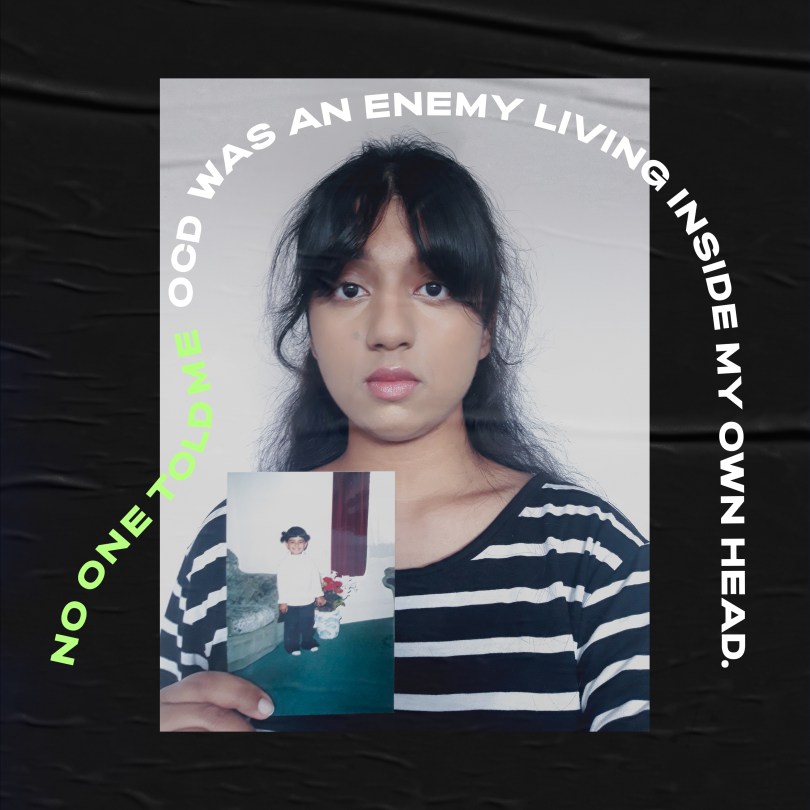
These thoughts can also occur at the most random, or inappropriate moments such as during family/public gatherings, sexual intimacy, meetings/interviews, funerals, weddings etc. Thoughts aren’t the only symptom either, OCD comes with physical sensations, urges/impulses too which causes further suffering. OCD does not care, it just wants to torment you. No one told me that OCD was an enemy living inside my own head.

The stigma surrounding the disorder is so great as has been established. This then contributes to individuals to not seek professional help out of fear, guilt, shame or misunderstanding. It is so crucial that OCD is recognised as a genuine illness and what the symptoms are to break this stigma. Then sufferers such as myself could have been treated much earlier and not suffer in silence for years. I hope the awareness that is brought will change how OCD is perceived. Chrissie Hodges is a great individual who accomplishes this on her YouTube channel and Instagram page. The organisation Made of Millions (who I have partnered with in sharing my story) strive to do so as well. Please check them out!

Thank you for reading, I do hope you are now aware of what OCD is and if you suffer from it yourself, that you know you aren’t alone. Also a special thank you to Made of Millions for encouraging and sharing our stories for their campaign #NoOneToldMe.

Take care of yourselves 🙂


It takes an average of 10 years for a person suffering from a psychiatric disorder to seek help. Half of which start before the age of 14. Each year spent suffering in silence, is a year lost.

This #mentalhealthawarenessmonth, I’m proud to partner with @madeofmillions_ for their #NoOneToldMe campaign focused on bringing awareness to the treatment gap — the long, avoidable years so many of us spend suffering in silence. Learn more at madeofmillions.com. If you’re in the U.S. and experiencing a crisis, text MADE to 741741 for free, 24/7 support.

1st year of university – the disturbing truth

So I’m nearing the end of my first year at university and once I finish my final exam, I can start packing and return home. Looking back, it has been a strange year. Before I moved into my halls, the feelings that coursed through my body were of excitement and joy, I couldn’t wait to start university.

Fast forward to December 2018 and I am in a messy state of anxiety and depression. Why did i become like this? The work I had to complete took a large toll on me. I was lonely with barely anyone to talk to or interact with and that was also partly due to my lack of social skills/anxiety. I didn’t feel as if i could approach anyone. My health plummeted so much that I ended up skipping lectures and tutorials because I just couldn’t get up out of bed. Not only that, my sleep cycle has very much been destroyed with irregular sleeping patterns. Despite speaking to my lecturer about my problems and attending counselling session, I felt as if I was a lost cause.

Now, as of May 2019, i still very much feel the same if not worse. I barely ever had breakfast. Once again, I skipped lectures and tutorials because I was ill. I was terrified of my assignment results but thankfully, I pulled through with some firsts. I have been anxious throughout this exam season and am anxious for exam results. I feel like a disappointment to my family for spending so much of their money and a disappointment to myself: that no matter how much I try I never seem to get better. I cried so much for days, feeling hopeless about whether I’ll ever feel good like my past self. Thoughts of me being dead entered my mind too…all of these exhibit my mental and physical state throughout this year and it makes me shed more tears. These past few days, I have experienced some joy thanks to the lovely people I have met this year. But now, as I’m writing this post, I have gone back to the same gloomy girl with no energy or desire and a puddle of tears, a shell of my former self. But this is nobody’s fault and it’s not mine either.

I’m awaiting the future where i will get help and this is something I encourage others to do as well. I’m working so hard to become better again and that is a promise I make to myself and my loved ones. Everyone goes through difficult times at university and I wanted to share my experiences.